FAQs

Monday – Friday: 9 AM – 5 PM PT
Saturday: 10 AM – 3 PM PT
Sunday: Closed
Schedule a call or Zoom meeting with a Member Advisor.
If you're a member, contact us through Digital Banking.
And here's a great place to start.
Checking & Spending
You can open a savings or checking account at the same time you become a member. Once you become a member, you can open additional accounts and apply for loans through Digital Banking. You can also open accounts at any Stanford FCU branch.
If you don’t have enough money in your account to cover a check, debit card purchase, recurring debit card or ACH transaction, your financial institution can either reject the transaction or cover it for you. When they cover or protect you from overdrawn accounts, it’s called “overdraft protection”. This can sometimes be embarrassing and expensive because most financial institutions charge a fee. In the case of a bounced check, the check recipient may also charge a fee.
There are three ways to manage transactions when there are insufficient funds:
- Reject the transaction - The financial institution can simply decline the transaction or send back a check you wrote. Note that the check or ACH can be re-submitted, and it will only process when you have enough money in your account. Many financial institutions charge a non-sufficient funds (NSF) fee for rejected items, but Stanford FCU does not.
- Account-to-account transfer - You can link your other accounts at the same financial institution to automatically transfer money into your account to cover a transaction when there isn’t enough money. At Stanford FCU you can set up your savings, money market or credit card to cover checks and ACH items. Most banks charge for these automatic account-to-account transfers (and for cash advance fees if you link to a credit card), but Stanford FCU does not, and never has.
- Courtesy Pay - You can opt into allowing your financial institution to cover transactions when you don’t have enough money, and they will charge a fee for each transaction. At Stanford FCU, Courtesy Pay will cover check, debit card, and ACH transactions. Courtesy Pay is free for transactions under $10, and will cover up to four transactions per day with a Premium OD/Courtesy Pay fee. Our fees are listed on our Schedule of Fees(link to Service Fees page).
Avoid rejected transactions with overdraft protection! Call 888.723.7328 or use Chat to set up account-to-account transfers and opt into Courtesy Pay to protect yourself if your account goes negative.
Your account balance is the total amount of money that is currently in your account, including any pending transactions (e.g., debit card purchases that have not cleared).
Your available balance is the total amount of money in your account that you can use for purchases and withdrawals, as it excludes pending transactions and check holds from your account balance. However, the available balance will not show checks that haven’t been cashed or deposits which haven’t posted.
You should always use the available balance to determine how much money you have available for purchases and withdrawals. Otherwise you might overdraw your account if you spend based on your account balance and it is higher than your available balance.
There are options available to protect you from an overdrawn account. Learn more about our overdraft protection options.
Stanford FCU is proud to be a part of the Bank On coalition with our free Everyday Spending account.
Bank On is a national platform for the 501(c)3 corporation Cities for Financial Empowerment (CFE) Fund. Bank On supports financial institutions in providing safe and affordable bank or credit union accounts for everyone.
According to Bank On, nearly 4.5% of U.S. households don’t have a checking or savings account. That’s approximately 5.9 million U.S. adults! Reasons for not having a basic account could include a lack of trust in financial institutions, higher fees, not enough money for the minimum balance, or problems with identification or credit history.
Without a bank or credit union account, many “unbanked” Americans turn to alternative financial services, such as check cashers or pawn shops, often paying exorbitant fees in the process. By choosing not to put money into a stable financial institution with minimal fees, “unbanked” individuals have a harder time building wealth and economic stability. They’re also more likely to be victims of crime, since many keep significant amounts of cash on hand.
In order to prevent this, the CFE Fund and Bank On work with financial institutions to promote and encourage the availability of more low cost or free accounts.
In order to be part of the Bank On coalition, financial institutions must adhere to a set of National Account Standards. These standards are basic requirements to ensure consumers have access to safe and affordable accounts.
There is no specific time, but your direct deposit will be posted to your account before 8:00 AM PT on your pay date, and we post the funds as soon as we receive the file from your employer (up to two days before payday!).
You can check your direct deposit and available balance easily through Digital Banking!
If you previously ordered checks through Stanford FCU and your information has not changed, you may reorder checks through Digital Banking by clicking here.
If any of your information has changed, you will need to contact us to place your order: Visit any of our branch locations, call a Member Advisor at 888.723.7328, or send a secure Message through Digital Banking.
Although you can order checks from any vendor, we strongly recommend that you order them through Stanford FCU’s preferred vendor. This helps ensure quality and security to ensure there are no issues with your checks. And the first box of checks is free for new members!
If you previously ordered checks through Stanford FCU and your information has not changed, you may reorder checks in Digital Banking.
You can also visit any of our branch locations or call a Member Care Team Specialist at 650.723.2509 or 888.723.7328 toll free.
Although this is the least secure and slowest way to make a deposit, you can mail a check for deposit to:
Stanford FCU
P.O. Box 10690
Palo Alto, CA 94303-0843
You can also stop by one of our branches, use a shared branch or deposit-taking ATM, or make a deposit with our Digital Banking.
Follow these steps to deposit a check through our Digital Banking:
- Endorse your check by signing the back
- Log into our Digital Banking, and go to Move Money or choose Deposit in the mobile app
- Select the account to deposit into
- Enter the check amount
- Place your check on a plain, dark surface and capture the front, then back
- Submit your deposit
- Follow any additional prompts
Retain the check for 90 days before destroying.
Note: There is a maximum check amount of $50,000.
All of our personal checking (spending) accounts are free, with no minimum balance or other requirements. For up-to-date information on our spending account requirements, visit our Personal Checking Account page.
Our Business Spending account does require a minimum balance to avoid a monthly service fee. For more information on Business Spending, visit our Business Checking account page.
You’ll also find that our account fees(link to Service Fees page) are considerably fewer and lower than the big banks!
Check holds vary based on the length of membership and the check amount. Click here to request a Check Hold Release through Digital Banking.
It’s easy to add or switch your direct deposit to Stanford FCU through your employer or the Social Security Administration. You can also use our Non-Federal Direct Deposit Enrollment Request Form to assist your employer if needed. You’ll need the following information:
- Stanford FCU’s routing number: 321177722
- Your account number (log in to Digital Banking, click on the three dots at the bottom of the account tile on the home page, and choose Account Details)
- Our address: Stanford Federal Credit Union, P.O. Box 10690, Palo Alto, CA 94303-0843
- Our phone number: 650.723.2509
Once your company receives the information or form, the direct deposit switches typically take 1-2 pay cycles.
There are several ways to sign up for direct deposit:
- You can sign up for direct deposit through your employer or through the government agency that issues your checks.
- You can use our Non-Federal Direct Deposit Enrollment Request Form to assist your employer if needed.
- You can also fill out a form provided by your employer or the government agency. You’ll need the following information:
- Stanford FCU’s routing number: 321177722
- Your account number (log in to Digital Banking, click on the three dots at the bottom of the account tile on the home page, and choose Account Details)
- Our address: Stanford Federal Credit Union, P.O. Box 10690, Palo Alto, CA 94303-0843
- Our phone number: 650.723.2509
Note: Your member number is not your account number. Each savings or checking account has a separate, unique account number. You can also find your account number on your checks:
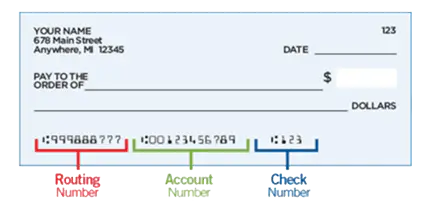
However you sign up for direct deposit, you’ll get your money up to two days before payday, because we always post payroll as soon as we receive your direct deposit!